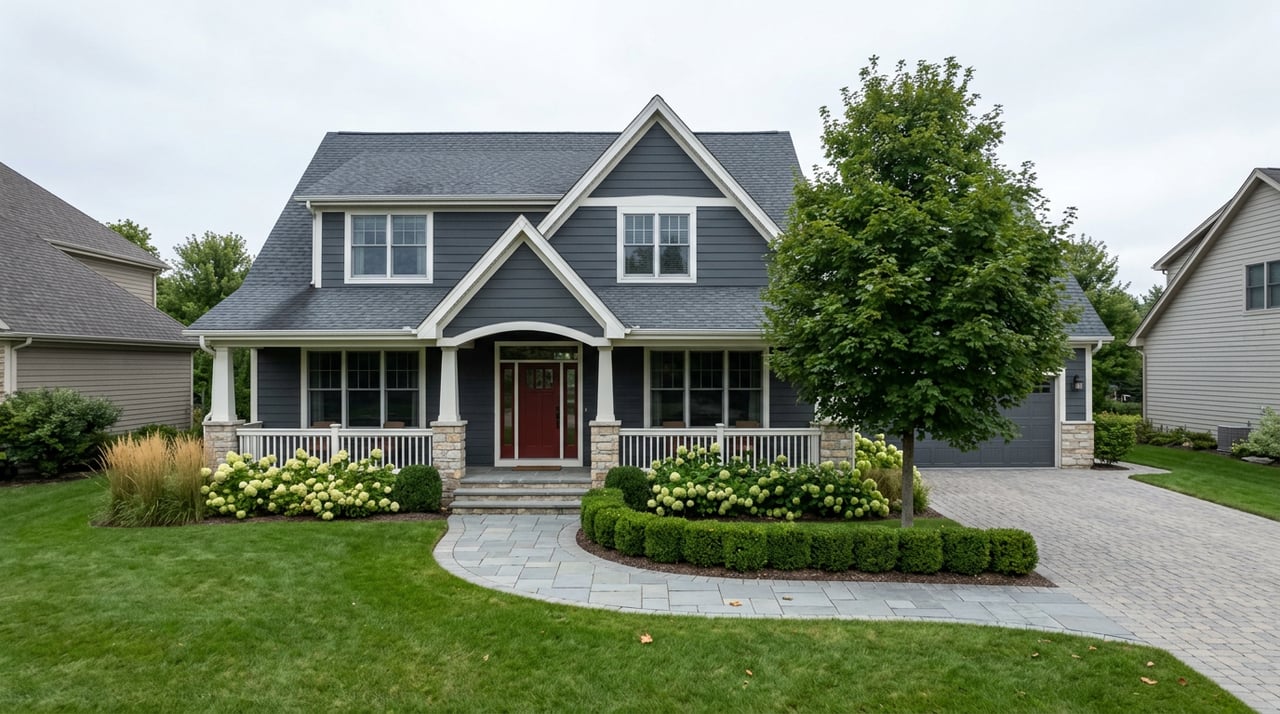
In Hinsdale, Nobody Fights to Save the Old House. They Fight Over What Replaces It.
A listing that says "teardown opportunity" in Hinsdale reads like a green light. The math seems simple: the land is worth more than the structure, the lot is buildable, so buy it, permit it, build it. But that phrase describes the economics of the dirt. It says nothing about which approval track the address sits on, and in Hinsdale, that track determines whether your project takes four months or fourteen.
The distinction rarely shows up where buyers expect it. Public hearing records from the village's Historic Preservation Commission over the past year and a half tell a consistent story: demolition itself almost never gets stopped. What stalls a project, sometimes for months, is a second and entirely separate vote on what you plan to build in the old house's place.
In spring 2025, the commission reviewed two demolitions on the same evening, both inside the Robbins Park Historic District. One was a 2½-story Prairie School home on East First Street, built around 1905 with five additions layered on over the decades. The homeowner had purchased it for nearly $3 million the previous June. The attorney representing the buyer described the house as disjointed inside, with none of the original windows or woodwork remaining. The commission approved both the demolition and the new design without objection.
The second address that night, a 1978 two-story on East Eighth Street built in a Shed style the village itself considers rare in Robbins Park, went differently. Commissioners approved the demolition unanimously. Then they voted 3-1 against the design of the replacement house, with one commissioner saying plainly:
"I just don't know that it's appropriate in the context of a historic district."
That split vote sent the matter to the elected Village Board for an advisory review. Under the village code, that board's vote doesn't carry veto power. The homeowners could still get permits if their plan met code. But the delay was real: another meeting cycle, another round of revisions, another few weeks before a shovel could go in the ground.
Compare that to a hearing in February 2026, when the commission unanimously approved both the demolition and a certificate of appropriateness for a new home on East Sixth Street in the same district. The applicant's representative had walked commissioners through a stone mock-up sourced from Wisconsin and answered a question about a small courtyard window on the spot. No 3-1 split. No trip to the board. Straight through.
Three demolitions, three unanimous approvals to tear down. One design sailed through, one didn't, and the third depended entirely on how well the replacement plan matched what the commission wanted to see on that specific block. Nothing about lot size, price paid, or the age of the existing structure predicted which way the design vote would go.
Public sale data from February 2026 put Hinsdale's broader median sale price at $951,250, a figure that includes plenty of the older, smaller homes that get marketed as teardown candidates. Finished new construction listed at a median of $1.6 million around the same window. That roughly $650,000 gap is often described as the cost of building, but it's more accurate to call it the cost of finishing a project that still has to clear design review if it sits inside a historic overlay.
The average single-family home in Hinsdale is about 50 years old, according to public property data, which means a large share of the housing stock looks like a plausible rebuild candidate on paper. Roughly 30 percent of homes in the village have already gone through a teardown and rebuild. That volume is exactly why the review process matters as due diligence, not paperwork: with so many properties cycling through it, the commission has an established pattern, and that pattern is visible if you look at recent case outcomes before you write an offer, not after.
Every demolition in the village, regardless of historic status, triggers a notice requirement: residents within 250 feet must be notified, and the village cannot issue a demolition permit until at least 30 days after that notice is certified. That 30-day floor applies everywhere. What changes inside Robbins Park or the downtown historic district, or for any address on the village's Historically Significant Structures Property List, is everything that happens on top of it.
| Step | Standard Hinsdale lot | Robbins Park, downtown, or listed historic structure |
|---|---|---|
| Neighbor notice before demolition | 250-ft radius, 30-day wait | Same 250-ft radius, 30-day wait |
| Design review for the replacement | Standard building permit only | Certificate of appropriateness required, including a preliminary application and a design review meeting with the Ad Hoc Historic District Design Review Team |
| Additional study sometimes required | None | Historic and Architectural Impact Study, at the applicant's expense, in some cases |
| If the commission splits on the design | Not applicable | Case can go to the Village Board for an advisory vote, adding a meeting cycle |
| Alternative to demolition | Not applicable | Eligible for alternative bulk zoning, fee waivers, property tax rebates, and expedited processing if the owner chooses renovation instead |
The left column is mostly a timing question. The right column is a design negotiation with an outcome you can't fully predict from the street.
Not every home marketed as a teardown candidate ends up as one. A house on South Clay Street had been advertised as a possible teardown for years. The owners, who bought it in 2021 for $615,000, had no interest in demolishing it. Instead, this year they applied for a village subsidy, roughly $9,000, to cover window replacement on an enclosed porch. Down the street, the owners of a 1926 Tudor Revival on South Washington Street sought a $10,000 subsidy toward a roughly 400-square-foot addition designed to replace a 1990s-era back addition with something more consistent with the home's original style. Both requests moved forward with the Historic Preservation Commission's recommendation.
Those subsidy amounts are small against a renovation budget. What makes the incentive program worth understanding isn't the dollar figure, it's what comes bundled with it: fee waivers, expedited processing, and alternative bulk zoning that can make an addition or a substantial renovation pencil out in a way a from-scratch rebuild, with its uncertain design vote, might not. For an owner sitting on a historically significant property, that program is a real fork in the road, and it's one that rarely appears in the marketing copy for a house listed as land value.
If you're evaluating a property advertised as a teardown opportunity in Hinsdale, the first question isn't whether the lot can support a bigger house. Village zoning tables already answer that with published minimum lot sizes, widths, and coverage caps by district. The question that actually changes your timeline is whether the address sits inside Robbins Park, the downtown historic district, or on the Historically Significant Structures Property List. That single fact determines whether you're buying a standard construction project or a design negotiation with a public body that has, in the last eighteen months, gone both ways on functionally similar proposals.
For sellers holding an older home in one of these districts, the incentive program is worth a serious look before defaulting to a teardown listing. A buyer paying near the top of the market, as the East First Street purchaser did at nearly $3 million, may still walk into a design fight even after clearing the demolition vote easily. That's not a reason to avoid these properties. It's a reason to build the review timeline into your offer strategy from the start, rather than discovering it at the second commission meeting.
Does a teardown listing in Hinsdale guarantee I can build what I want? No. It confirms the land is buildable under code. It says nothing about whether a certificate of appropriateness will be required, or how a specific commission has ruled on similar designs recently.
How would I know if a property is in a historic overlay before I make an offer? Ask directly, and check whether the address appears on the village's Historically Significant Structures Property List or falls inside the Robbins Park or downtown historic district boundaries. This is a factual question with a factual answer, and it should be answered before, not after, you're under contract.
If the design gets rejected, is the project dead? Not necessarily. A split commission vote sends the matter to the Village Board, whose vote is advisory. A code-compliant plan can still move forward. What you lose is time, not necessarily the project itself.
If you're weighing a property marketed as a teardown in Hinsdale, or wondering whether your own historic home has more upside preserved than replaced, Natalie Ryan and Anna Fiascone at AFNR Homes can walk through the specific review path for that address before you write an offer or set a list price. Schedule a complimentary market consultation and bespoke listing plan to get a clear read on the process ahead, not just the price per square foot.
AFNR Homes is committed to providing exceptional service and unmatched expertise in the real estate market. Whether you're purchasing, selling, or investing, AFNR Homes stands as your reliable partner for all your real estate requirements. Start working with them today!