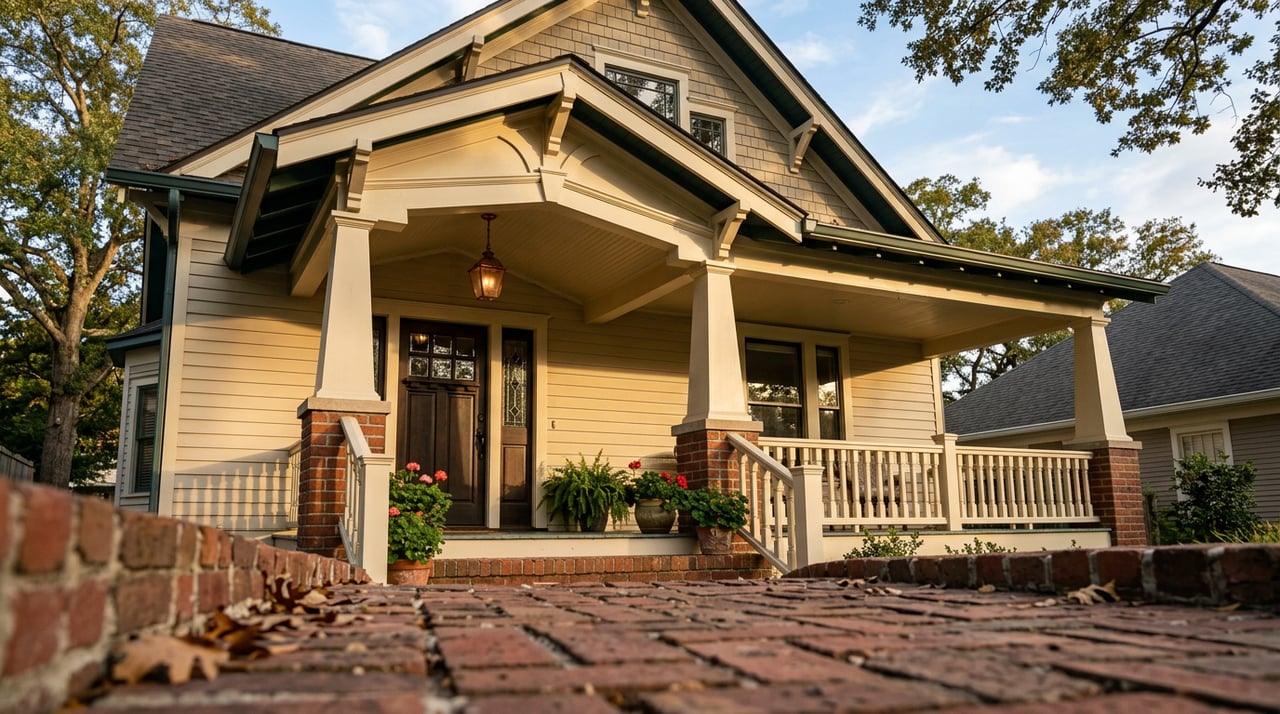
What Naperville's New Historic District Survey Means Before You List, Buy, or Touch a Porch
A consulting firm named Ramsey Historic Consultants spent the better part of a year walking every block inside Naperville's Local Historic District, camera in hand, comparing what stands today against a survey the city commissioned back when gas cost under two dollars a gallon. The city hired the firm in the fall of 2025. The finished report landed in June 2026. For the roughly 320 properties inside the district, that closes an 18-year gap between the paperwork and the porches.
Most guides to buying or selling in this pocket of Naperville treat the Certificate of Appropriateness process as a fixed set of rules you either follow or don't. That misses what actually changed this year. The district's oldest working document, the one that determines how a given property gets evaluated when someone wants to swap a window or rebuild a fence, was last updated in 2008 under the Granacki survey. Anyone who bought, sold, or renovated in this district since then was operating against a snapshot from nearly two decades ago. The new survey doesn't just refresh the photos. It logs Certificate of Appropriateness history against each parcel and updates significance ratings property by property. If you're closing on a home here, or listing one, that record now exists in a form a title search or a buyer's attorney can actually find.
Before getting into what the survey changes, it helps to know what this district actually is, because the reputation and the reality don't match.
Naperville's City Council created the Local Historic District in 1986. It was not a popular move at the time. Only 16% of the property owners inside the proposed boundaries supported it. That's worth sitting with for a second: a district that today anchors some of the strongest home values downtown started as something four out of five owners didn't want.
What happened next is the more interesting part. Rather than harden into a bureaucratic wall, the rules loosened over time. By the late 1990s and early 2000s, as renovation and demolition activity picked up on the older housing stock, residents pushed back on rigid material requirements. The city didn't dig in. It formed a steering committee of staff, homeowners, and preservation groups, and the city's historic-district regulations page describes a 2011 ordinance that gave homeowners more flexibility on materials.
The outcome of that compromise shows up in a number that should reassure anyone worried the district is a minefield: since 1986, there have been only about five complete demolitions inside the entire historic district. Not five per year. Five, total, across four decades. Whatever friction exists in this process, it has not translated into people bulldozing their way out of it.
The Mayors Caucus page says the Historic Preservation Commission has nine members serving three-year terms, and at least four seats must be filled by owners or residents of a designated landmark or a property inside the district. It's neighbors reviewing neighbors' plans, not an outside board imposing rules on a community it doesn't live in.
The COA process concerns exterior changes to a property that's landmarked or sits inside the district boundary.
The city's own regulations page confirms that some improvements are exempt entirely, and the exemptions matter as much as the requirements do for anyone planning pre-listing work: certain minor projects can be approved administratively by staff rather than waiting for a full commission hearing. That distinction is worth confirming with the city before a seller commits to a timeline, because the difference between a staff sign-off and a commission review is measured in weeks, not days.
This is the part that actually changes how you plan a listing. From a complete submission, a straightforward COA decided administratively by staff can take one to four weeks. If it needs to go before the full Historic Preservation Commission, which meets on a bi-monthly schedule, plan for four to eight weeks from a complete application to a decision. Additions and demolition requests run longer still, often three months or more once permit review is layered on top of the approval.
For a seller thinking about exterior refresh work before photos and showings, that math has to happen before the "list by" date gets set, not after. A new front door that changes the profile of the original opening, a fence swap, a change to exterior lighting, any of these is worth checking with the city before you set a timeline. Building an 8 to 12 week buffer into a pre-listing plan for any exterior project inside the district isn't caution for its own sake. It's the difference between a smooth spring listing and a summer delay nobody budgeted for.
Here's the mechanism that most coverage of this district misses entirely, because most of it predates the update.
Before this year, if a previous owner did exterior work without pulling a COA, the only record of it lived in whatever paper file the city happened to have, cross-referenced against a 2008 baseline that may not have reflected what the house looked like by the time work was done. A buyer's attorney doing diligence had to go looking for a problem that might not surface in any obvious place.
The 2026 survey changes that by design. It includes updated photographs, updated significance ratings, and specifically, information from city records regarding any Certificates of Appropriateness granted to a property. That's a documented, current-as-of-2026 baseline for all 320 parcels, not a patchwork of decades-old notes. Unauthorized exterior work that happened in the gap years now has a much better chance of surfacing during a transaction, because the comparison point the survey creates is fresh rather than stale.
For sellers, that argues for getting ahead of it. If exterior work happened on the property without a COA at some point in its history, this is the year that gap is most likely to be visible to a careful buyer or their attorney, since the survey just re-anchored what "before" looked like. For buyers, it means the assumption that "no COA on file" equals "no restriction" is weaker than it used to be. The updated survey is the new reference point going forward, and any exterior change from here gets measured against it, not against a photo from the Bush administration.
None of this is unique to houses. The district includes the campus of North Central College and six recognized local landmarks, among them the Truitt House and the Thomas Clow House, all of which sit inside the same review framework as the residential streets around them. The character that makes downtown Naperville's historic core desirable to buyers in the first place is the same character this process exists to protect, and the fresh documentation is what keeps that protection enforceable rather than theoretical.
How do I find out if a specific property is inside the boundary? The city maintains a mapping tool that shows whether an address falls within the local historic district, and it's worth checking before assuming either way, since the boundary doesn't always match intuition about which blocks feel historic.
If you're weighing a purchase inside this district, or you're sitting on a legacy property here and wondering what a pre-listing plan should actually include, that's exactly the kind of question worth working through before an offer goes in or a sign goes up. Natalie Ryan and the AFNR Homes team handle this kind of transaction detail as a matter of course, from timing exterior work around a review calendar to coordinating the concierge improvements that get a listing ready without a surprise delay. Schedule a complimentary market consultation and bespoke listing plan to talk through what your Naperville property's history actually means for your timeline.
This article is general information, not legal, tax or financial advice. Consult a qualified professional about your situation.

AFNR Homes is committed to providing exceptional service and unmatched expertise in the real estate market. Whether you're purchasing, selling, or investing, AFNR Homes stands as your reliable partner for all your real estate requirements. Start working with them today!